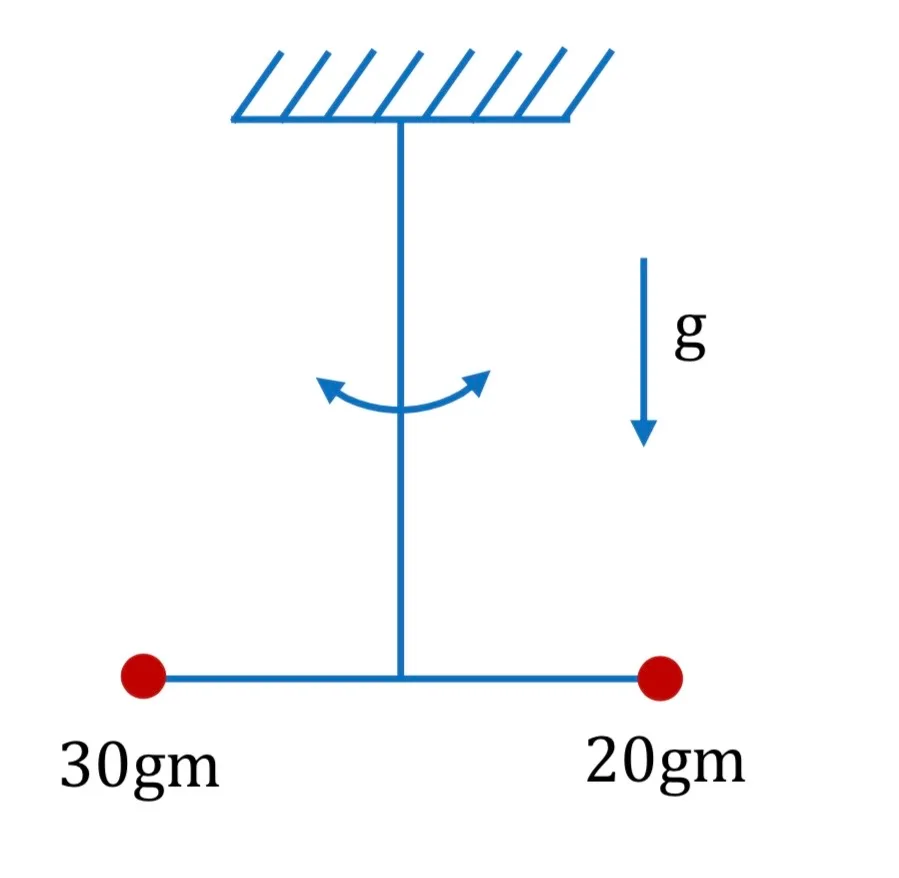
Two point-like objects of masses 20 gm and 30 gm are fixed at the two ends of a rigid massless rod of length 10 cm. This system is suspended vertically from a rigid ceiling using a thin wire attached to its center of
Physics · Simple Harmonic Motion · Physical Pendulum, Torsional Pendulum and Superposition of SHM
Two point-like objects of masses 20 gm and 30 gm are fixed at the two ends of a rigid massless rod of length 10 cm. This system is suspended vertically from a rigid ceiling using a thin wire attached to its center of mass, as shown in the figure. The resulting torsional pendulum undergoes small oscillations. The torsional constant of the wire is 1.2 × 10⁻⁸ N m rad⁻¹. The angular frequency of the oscillations is n × 10⁻³ rad s⁻¹. The value of n is [enter value].
Related questions
- For a particle executing SHM with amplitude a, at what displacement magnitude are its kinetic and potential energies equal?
- What is the potential energy, measured from equilibrium, of a particle of mass m executing SHM with angular frequency ω and amplitude a at…
- A spring–mass oscillator contains sand that leaks gradually from the attached box. Which pair of schematic graphs shows how angular frequen…
- Identical point masses P and Q oscillate vertically on springs of constants k₁ and k₂. If both oscillators have equal maximum speeds, find…
- Savitha, a XI standard student, while conducting an experiment to determine the effective length of a simple pendulum L, notes down the dat…
- A simple pendulum bob of mass 20 g has total mechanical energy (kinetic plus potential) 0.02 J. Find the approximate speed when it passes t…