At the origin a charged particle (electron or proton) is introduced with specified initial velocity. Uniform electric and magnetic fields are chosen from the following columns:
Physics · Magnetic effect of current
At the origin a charged particle (electron or proton) is introduced with specified initial velocity. Uniform electric and magnetic fields are chosen from the following columns:
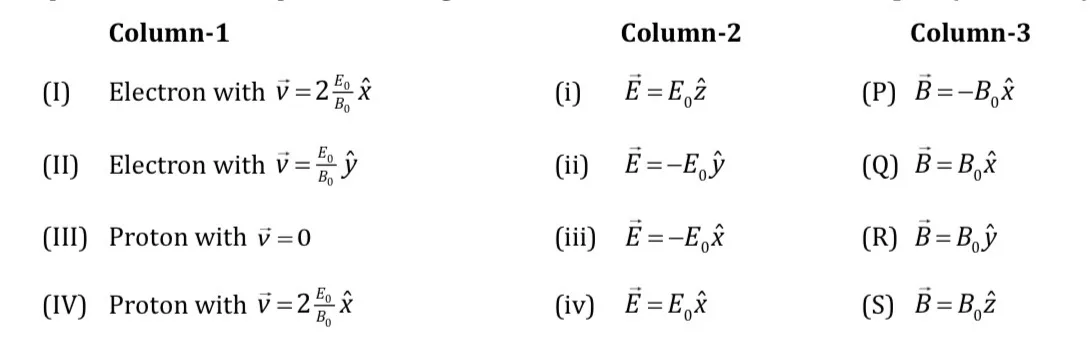
Sub-question 1
In which case will the particle move in a straight line with constant velocity?
Options
Sub-question 2
In which case will the particle describe a helical path with axis along +z?
Options
Sub-question 3
In which case will the particle move in a straight line along -y?
Options
Related questions
- A uniform magnetic field B points vertically upwards. Three straight horizontal wires of equal length L each carry a current i. The first p…
- An infinitely long straight conductor carries a current of 5 A. An electron moves parallel to it at speed 10⁵ m/s. At the instant shown it…
- A very long straight wire carries current I. At an instant, a positive charge +Q at point P moves with velocity v⃗ as shown in the diagram.…
- Ionised hydrogen atoms and α-particles enter perpendicular to a uniform magnetic field B with the same momentum. What is the ratio of radii…
- A particle of mass 10⁻² kg and charge 5 × 10⁻⁸ C is given a horizontal velocity 10⁵ m/s in electric and magnetic fields. To maintain horizo…
- Under the influence of a uniform magnetic field, a charged particle moves with constant speed v in a circle of radius R. The time period of…