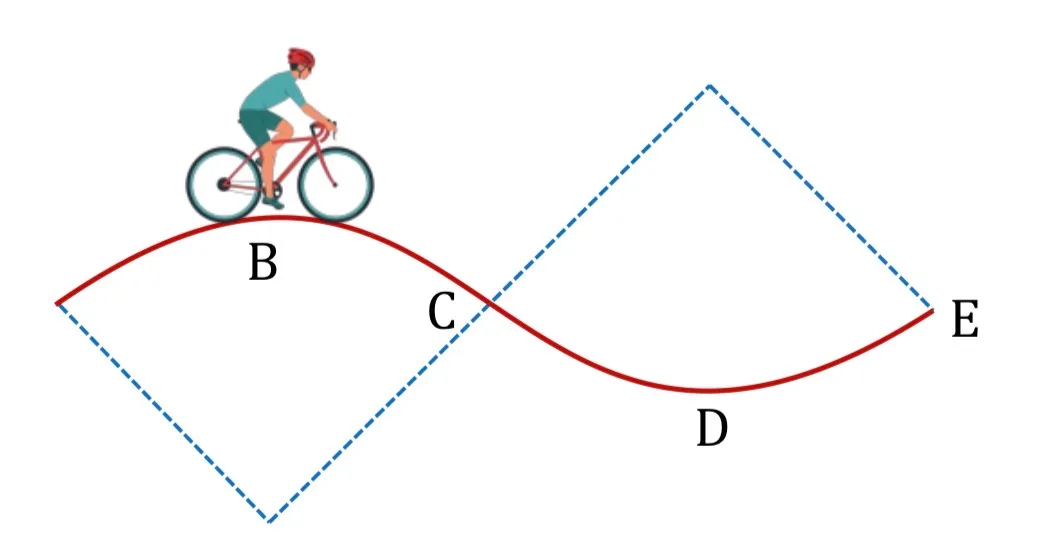
A track consists of two circular parts ABC and CDE of equal radius 100 m and joined smoothly as shown in figure. Each part subtends a rights angle at its centre. A cycle weighing 100 kg together with the rider travels at a constant speed of 18 km/h on the track. (a) Find the normal contact force by the road on the cycle when it is at B and at D. (b) Find the force of friction exerted by the track on the tyres when the cycle is at B, C, and D. (c) Find the normal force between the cycle crosses C. (d) What should be the minimum friction coefficient between the road and the tyre, which will ensure that the cyclist can move with constant speed? (Take g = 10 m/s²)
Physics · Circular Motion · friction and circular motion
A track consists of two circular parts ABC and CDE of equal radius 100 m and joined smoothly as shown in figure. Each part subtends a rights angle at its centre. A cycle weighing 100 kg together with the rider travels at a constant speed of 18 km/h on the track.
(a) Find the normal contact force by the road on the cycle when it is at B and at D.
(b) Find the force of friction exerted by the track on the tyres when the cycle is at B, C, and D.
(c) Find the normal force between the cycle crosses C.
(d) What should be the minimum friction coefficient between the road and the tyre, which will ensure that the cyclist can move with constant speed? (Take g = 10 m/s²)
Options