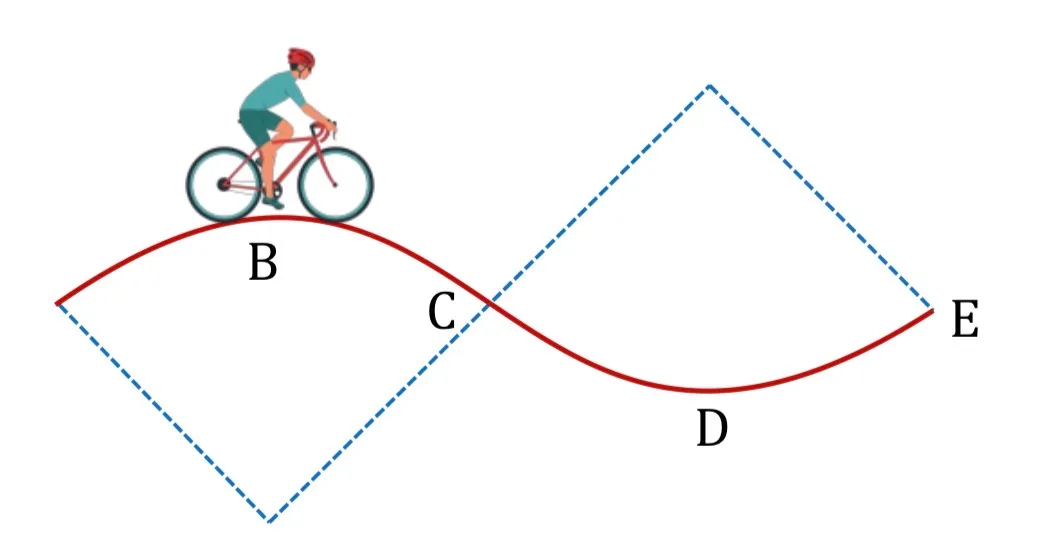
A track consists of two circular parts ABC and CDE of equal radius 100 m and joined smoothly as shown in figure. Each part subtends a rights angle at its centre. A cycle weighing 100 kg together with the rider travels
Physics · Circular Motion · Friction in Circular Motion
A track consists of two circular parts ABC and CDE of equal radius 100 m and joined smoothly as shown in figure. Each part subtends a rights angle at its centre. A cycle weighing 100 kg together with the rider travels at a constant speed of 18 km/h on the track.
(a) Find the normal contact force by the road on the cycle when it is at B and at D.
(b) Find the force of friction exerted by the track on the tyres when the cycle is at B, C, and D.
(c) Find the normal force between the cycle crosses C.
(d) What should be the minimum friction coefficient between the road and the tyre, which will ensure that the cyclist can move with constant speed? (Take g = 10 m/s²)
Options
Related questions
- A motorcycle travels along a level circular track of radius 500 m. The coefficient of static friction between the tyres and the road is 0.5…
- Which of the following statements is false for a particle moving in a circle with a constant angular speed?
- The angular speed of a flywheel is uniformly increased from 60 rpm to 1200 rpm in 10 s. How many revolutions are completed during this time?
- A car moves around a circular banked track of radius 50 m at speed 10 m s⁻¹. For minimum tyre friction/wear, find bank angle θ, using g = 1…
- A disc rotates with constant angular velocity ω. In the rotating frame, F r o t F_{rot} F r o t = Fᵢₙ + 2m( V r o t V_{rot} V r o t × ω…
- A particle starts from the point (0m, 8m) and moves with uniform velocity of ˆ 3 i m/s. After 5 seconds, the angular velocity of the partic…