A block P of mass m is on a frictionless horizontal surface. Another block Q of the same mass is kept on P and connected to a wall by a spring of spring constant k. μₛ is the coefficient of friction between P and Q. The blocks move together in SHM of amplitude A. The maximum friction force between P and Q is:
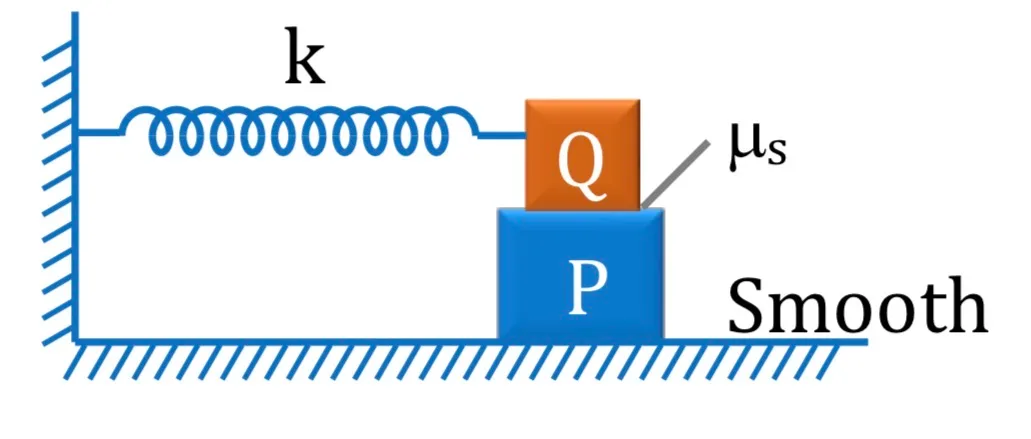
Options
Related questions
- For a particle executing SHM with amplitude a, at what displacement magnitude are its kinetic and potential energies equal?
- What is the potential energy, measured from equilibrium, of a particle of mass m executing SHM with angular frequency ω and amplitude a at…
- A spring–mass oscillator contains sand that leaks gradually from the attached box. Which pair of schematic graphs shows how angular frequen…
- Identical point masses P and Q oscillate vertically on springs of constants k₁ and k₂. If both oscillators have equal maximum speeds, find…
- Savitha, a XI standard student, while conducting an experiment to determine the effective length of a simple pendulum L, notes down the dat…
- A simple pendulum bob of mass 20 g has total mechanical energy (kinetic plus potential) 0.02 J. Find the approximate speed when it passes t…