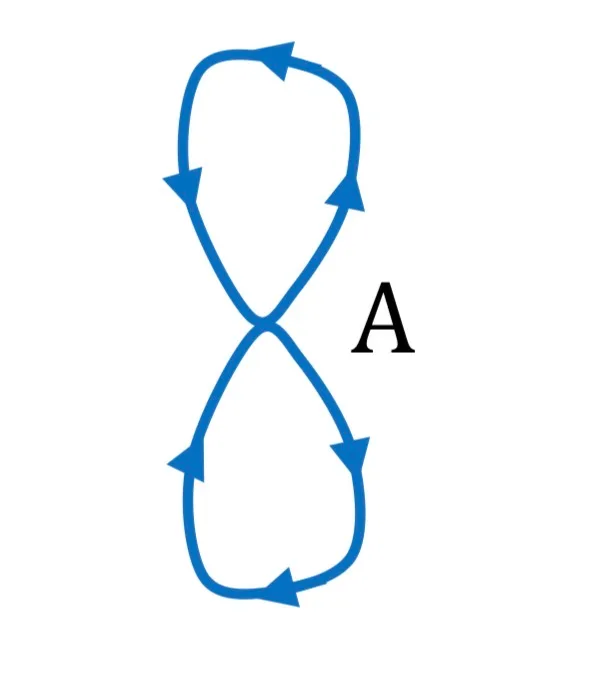
Lissajous figures are produced by superposition of 2 SHM's in mutually perpendicular directions. If both SHM have same frequency, the lissajous figure is simple. It may be a circle, ellipse or a straight line depending on the phase difference between two SHMs. Interesting case occurs when one of the SHM is at double frequency of another. Suppose a body executes SHM vertically with frequency f o f_{o} f o , but horizontally with a frequency 2 f o f_{o} f o and is initially at A, mean position of vertical as well as horizontal SHM. It can be seen to trace out a figure of 8 in space as shown. Since horizontal SHM has half the time period, it executes two horizontal oscillations by the time it completes a vertical oscillation.
Physics · Simple Harmonic Motion
Lissajous figures are produced by superposition of 2 SHM's in mutually perpendicular directions.
If both SHM have same frequency, the lissajous figure is simple. It may be a circle, ellipse or a straight line depending on the phase difference between two SHMs. Interesting case occurs when one of the SHM is at double frequency of another. Suppose a body executes SHM vertically with frequency , but horizontally with a frequency 2 and is initially at A, mean position of vertical as well as horizontal SHM. It can be seen to trace out a figure of 8 in space as shown. Since horizontal SHM has half the time period, it executes two horizontal oscillations by the time it completes a vertical oscillation.
Sub-question 1
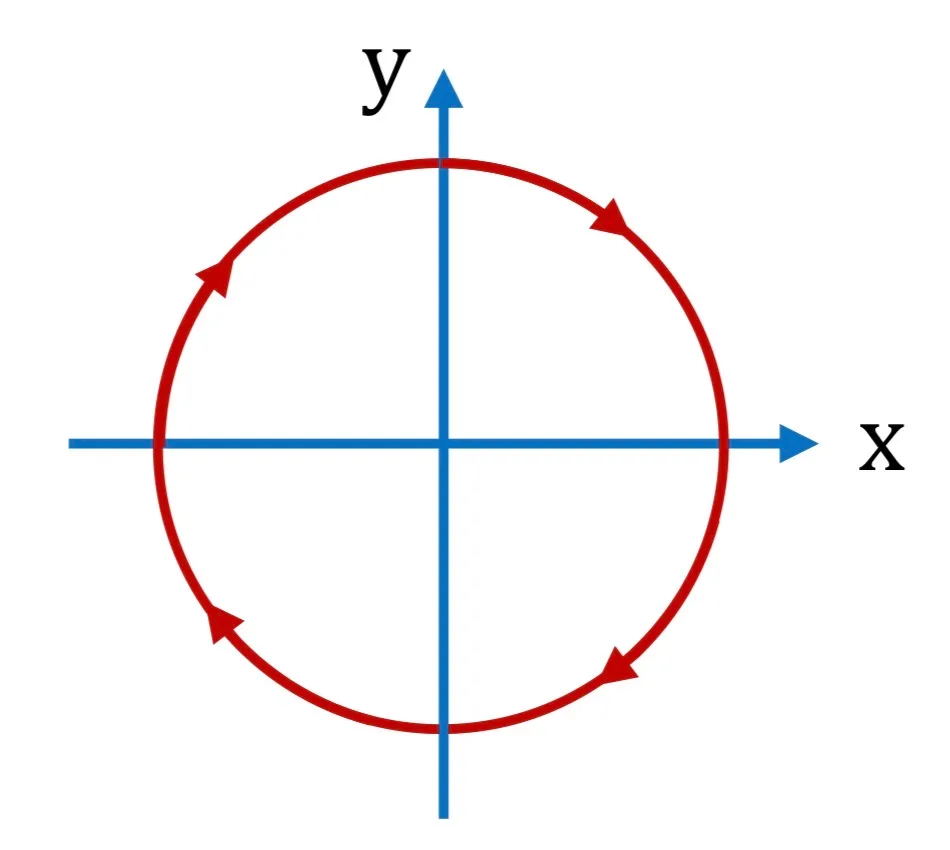
A Lissajous figure as shown can be produced by:
Options
Sub-question 2
For the shown Lissajous figure, the vertical frequency is times the horizontal frequency.

Options