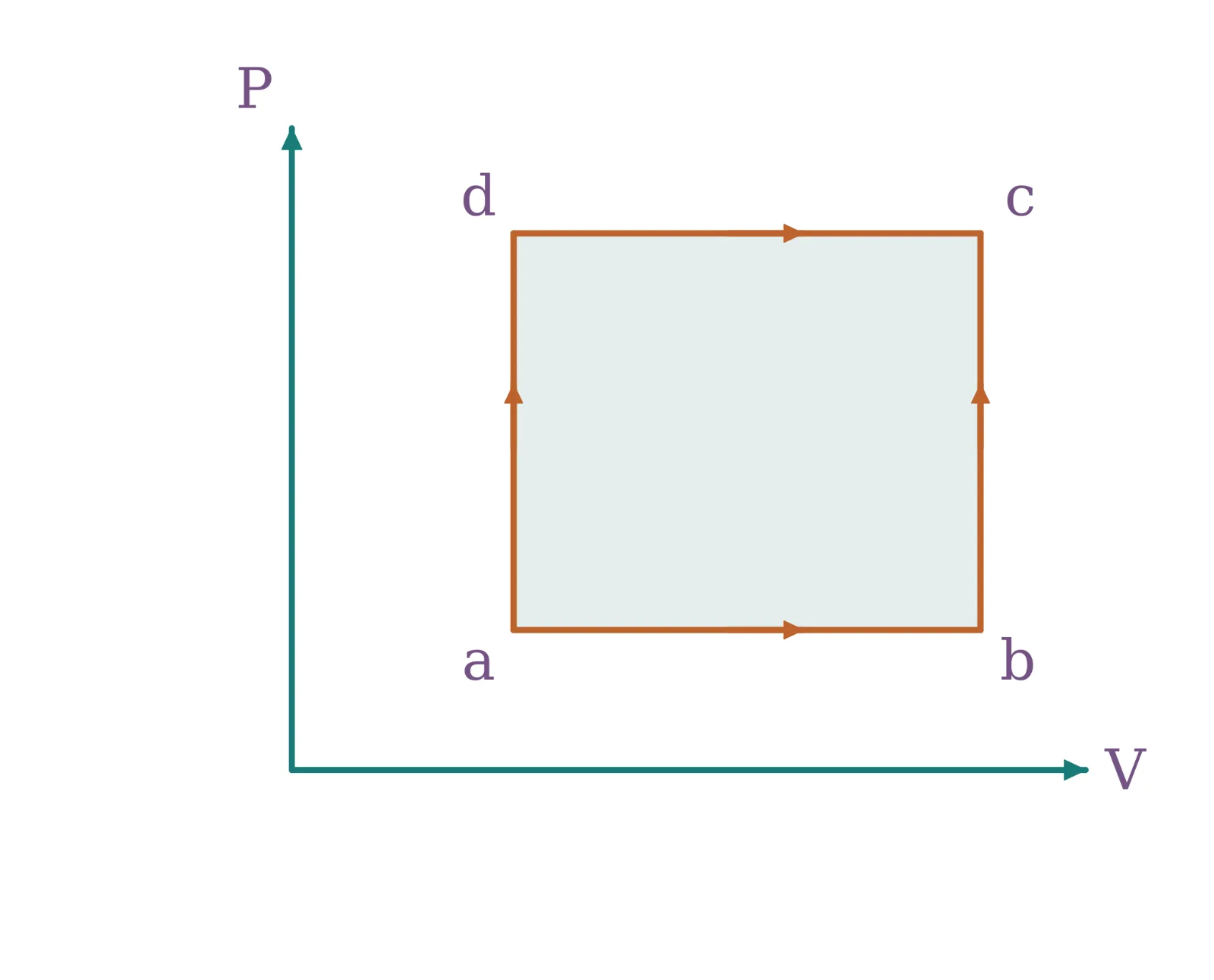
A system goes from state a to state c along paths adc and abc on the P–V diagram. Initially Uₐ = 10 J. Along adc, the heat absorbed is Q₁ = 50 J and work obtained is W₁ = 20 J. Along abc, the heat absorbed is Q₂ = 36
Physics · Thermodynamics · First Law of Thermodynamics and Its Applications
A system goes from state a to state c along paths adc and abc on the P–V diagram. Initially Uₐ = 10 J. Along adc, the heat absorbed is Q₁ = 50 J and work obtained is W₁ = 20 J. Along abc, the heat absorbed is Q₂ = 36 J. The work obtained along abc is:
Options
Related questions
- The average kinetic energy of hydrogen molecules at 300 K is E. At the same temperature, the average kinetic energy of oxygen molecules wil…
- A system does 333 cal of work and its internal energy increases by 167 cal. How much heat is supplied to the system?
- If amount of heat given to a system be 50 J and work done on the system be 15 J, then change in internal energy of the system is
- The blackbody spectrum per unit wavelength at temperature T peaks at wavelength λ₀. At which wavelength does it peak at temperature 2T?
- A 30 L oxygen cylinder initially contains 18.20 mol of O₂. After some gas is withdrawn, its gauge pressure is 11 atm at 27°C. Calculate the…
- Three identical rods are thermally connected in series. The left and right rods have conductivity 2K and the middle rod conductivity K. The…