Free question bank
First Law of Thermodynamics and Its Applications questions with solutions
Practice Thermodynamics questions for NEET and JEE Main. Attempt each question, then open the solution. Full revision programs are in the Physics courses.
Showing 1–10 of 47 questions
- A/ReasyThermodynamics
Given below are two statements. One is labelled as Assertion A and the other is labelled as Reason R.
Assertion
If dQ and dW represent the heat supplied to the system and the work done on the system respectively, then according to the first law of thermodynamics dQ = dU - dW.
Reason
First law of thermodynamics is based on law of conservation of energy.
Options
JEE Mains29 January 2023Shift 1Morning Shift
Open solution - MCQmediumThermodynamics
One mole of an ideal diatomic gas expands from volume V to 2V isothermally at a temperature 27°C and does W joule of work. If the gas undergoes same magnitude of expansion adiabatically from 27°C doing the same amount of work W, then its final temperature will be (close to) __________ °C.
Options
JEE Mains 202623 January Evening Shift
Open solution - MCQmediumThermodynamics
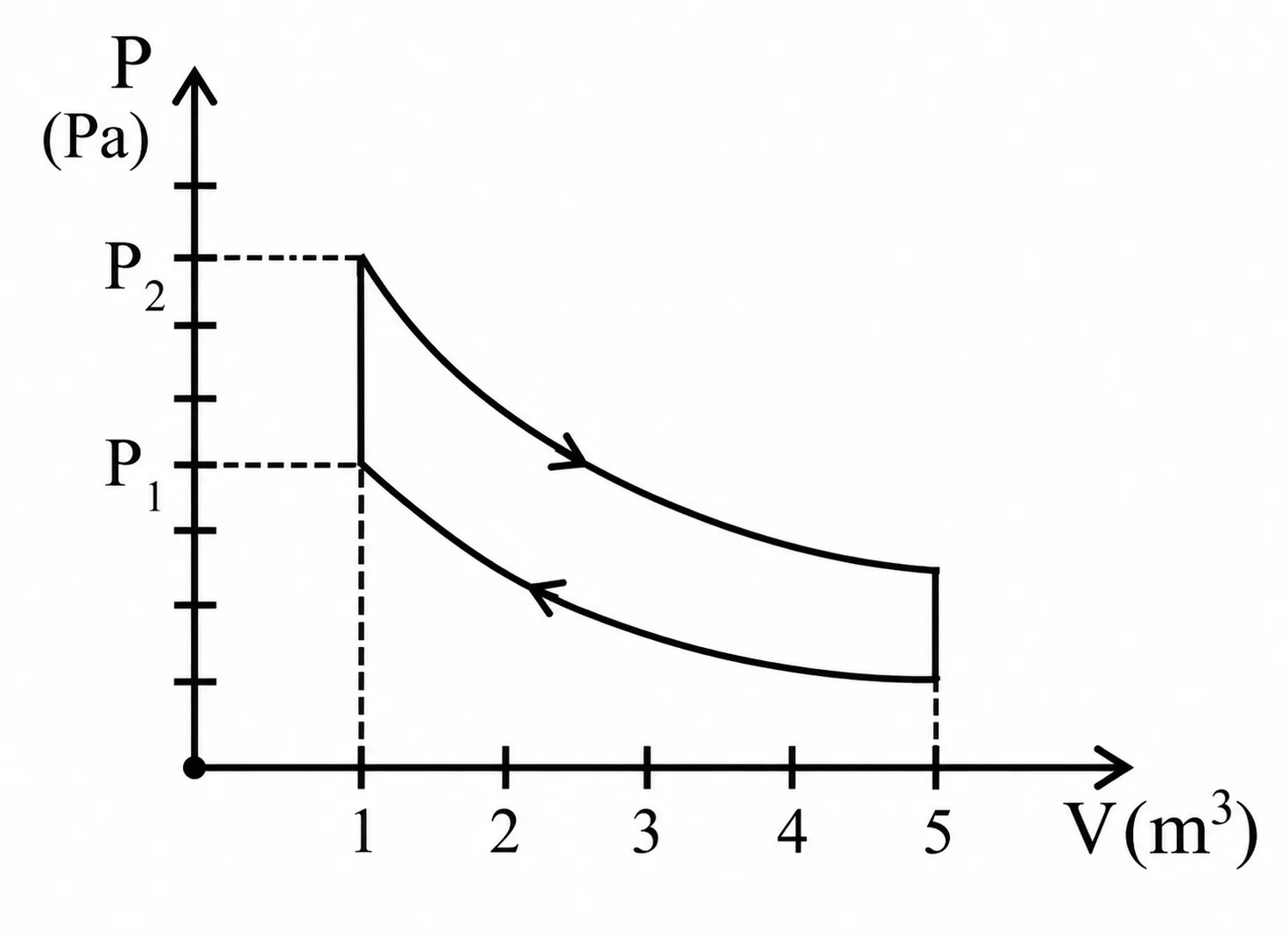
10 mole of an ideal gas is undergoing the process shown in the figure. The heat involved in the process from P₁ to P₂ is α Joule (P₁ = 21.7 Pa and P₂ = 30 Pa, Cv = 21 J/K·mol, R = 8.3 J/mol·K). The value of α is ____.
Options
JEE Mains 202624 January Evening Shift
Open solution - MCQeasyThermodynamicsOpen solution
One mole of an ideal gas requires 207 J of heat to raise the temperature by 10 K when heated at constant pressure. If the same gas is heated at constant volume to raise the temperature by the same 10 K, the heat required is:
Options
- MCQeasyThermodynamics
For an ideal monoatomic gas undergoing an isobaric process, the ratio ΔQ/ΔU is:
Options
JEE Mains 2025 24 Jan Morning Shift
Open solution - MCQmediumThermodynamicsOpen solution
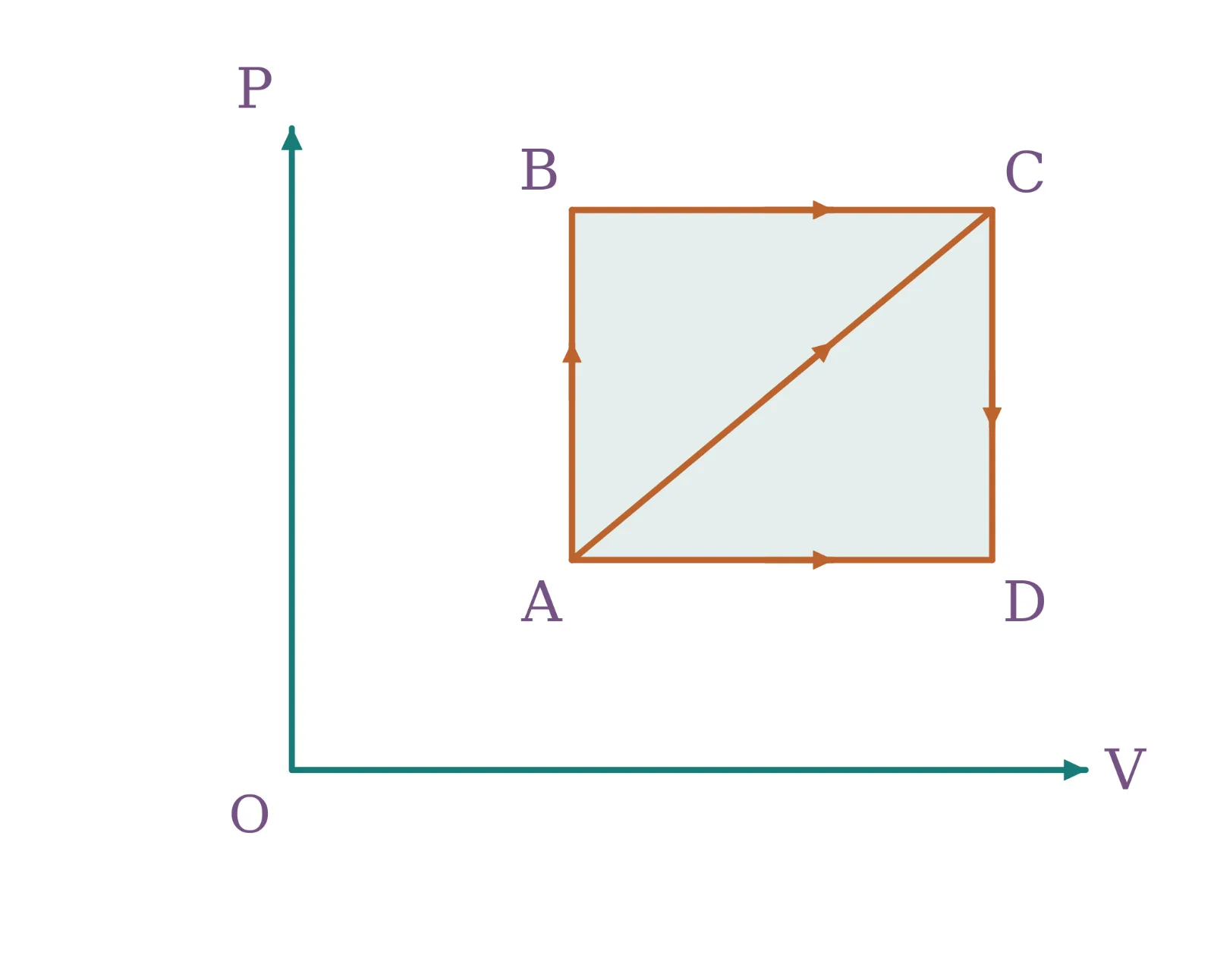
A thermodynamic process is shown in the P–V diagram. The pressure at A is 3 × 10⁴ Pa, the volume at A is 2 × 10⁻³ m³, the pressure at B is 8 × 10⁴ Pa, and the volume at D is 5 × 10⁻³ m³. In process AB, 600 J of heat is added to the system. The change in internal energy of the system in process AC would be:
Options
- MCQmediumThermodynamics
1g of a liquid is converted to vapour at 3 × 10⁵ Pa pressure. If 10% of the heat supplied is used for increasing the volume by 1600 cm³ during this phase change, then the increase in internal energy in the process will be :
Options
JEE Mains24 January 2023Shift 1Morning Shift
Open solution - MCQeasyThermodynamics
A source supplies heat to a system at the rate of 1000 W. If the system performs work at a rate of 200 W. The rate at which internal energy of the system increase is
Options
JEE Mains6 April 2023Shift 1Morning Shift
Open solution - MCQmediumThermodynamics
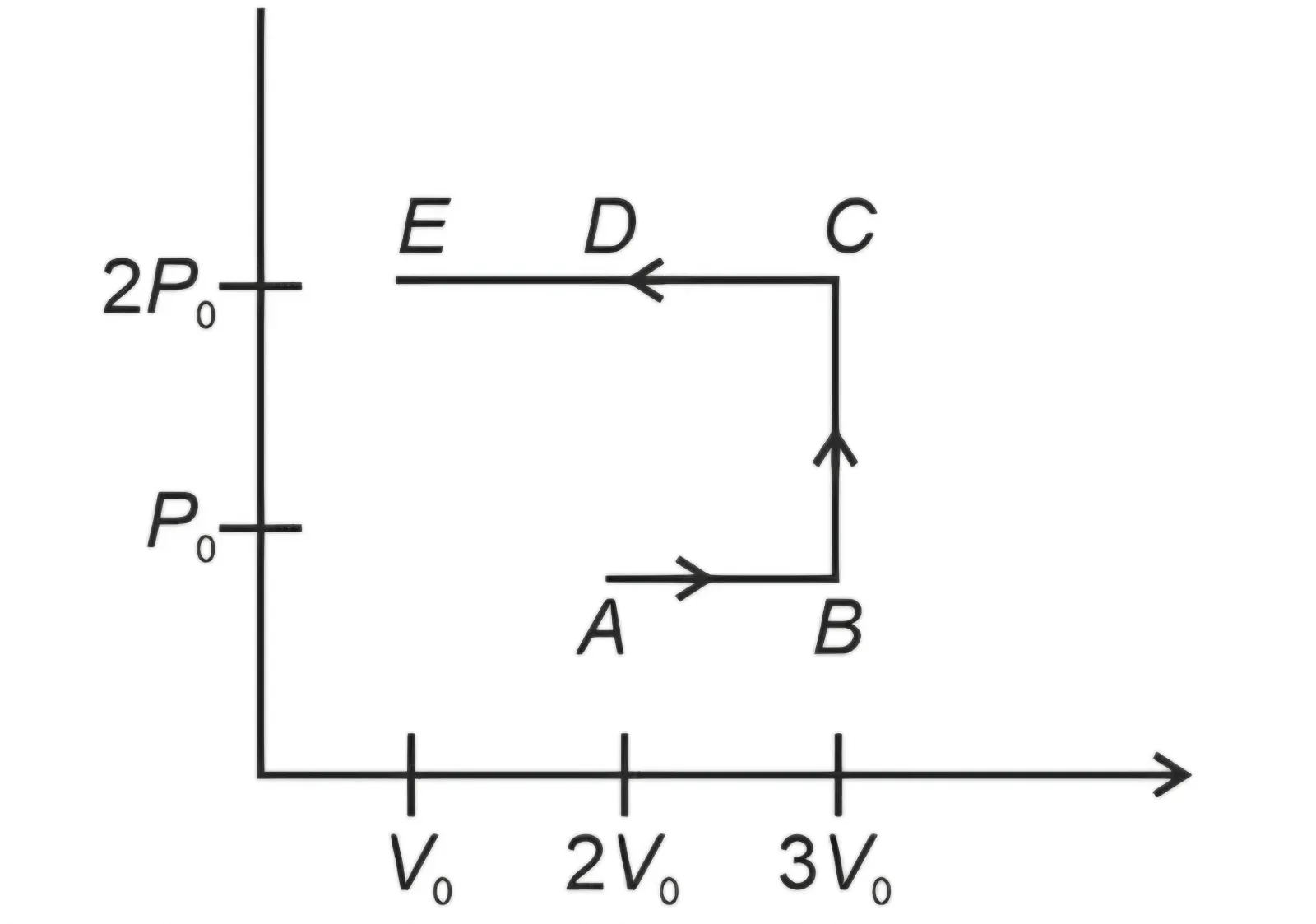
In the P–V diagram, a gas goes A(2V₀,P₀) → B(3V₀,P₀) → C(3V₀,2P₀) → D(2V₀,2P₀) → E(V₀,2P₀). Find the total work done by the gas from A to E.
Options
JEE Mains 2025 23 Jan Evening Shift
Open solution - MCQeasyThermodynamics
A total of 48 J heat is given to one mole of helium kept in a cylinder. The temperature of helium increases by 2°C. The work done by the gas is : (Given, R = 8.3 J K⁻¹ mol⁻¹.)
Options
JEE Mains 2024 06 Apr Evening Shift
Open solution