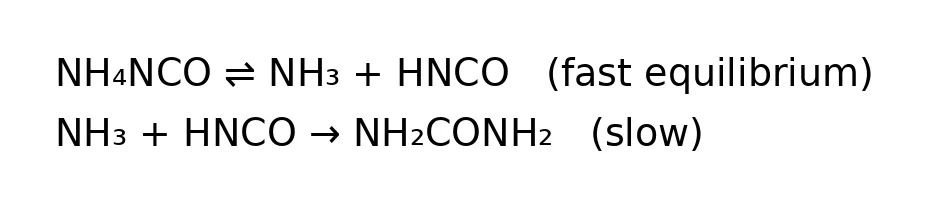
Consider this explicitly defined pre-equilibrium model for urea formation: NH₄NCO ⇌ NH₃ + HNCO (fast equilibrium, K = [NH₃][HNCO]/[NH₄NCO]) NH₃ + HNCO → NH₂CONH₂ (slow elementary step, rate constant kₛ) Which rate
Chemistry · Chemical Kinetics · Rate Law and Order: Rate constant, order of reaction, molecularity, and elementary and complex reactions.
Consider this explicitly defined pre-equilibrium model for urea formation: NH₄NCO ⇌ NH₃ + HNCO (fast equilibrium, K = [NH₃][HNCO]/[NH₄NCO]) NH₃ + HNCO → NH₂CONH₂ (slow elementary step, rate constant kₛ) Which rate expressions follow? Let k(obs) = kₛK.
Select all that apply
Related questions
- If a unimolecular reaction, A(g)→ Products, takes place according to the mechanism Where k₁,k₋₁ and k₂ are the rate constants and P, A and…
- For an elementary step aA + bB → products, the rate law is r = k[A]ᵃ[B]ᵇ. A multistep mechanism requires the rate-determining step or an ap…
- For 3A → 2B, initially [A]₀ = 20 mol L⁻¹ and [B]₀ = 0. At the intersection of the concentration–time curves shown, [A] = [B]. Find [B] at t…
- Following is the graph between log₁₀ t₁⁄₂ and log₁₀ a (a initial concentration) for a given reaction at 27°C Find the order of reaction ck_…
- A reactant disappears through two independent parallel first-order pathways with individual half-lives 4 h and 12 h, as shown. Find the eff…
- In a positive-barrier energy profile, the transition state lies above each endpoint. The forward barrier is Eₐ,f = E‡ − E(reactants); the r…