Free physics question bank
JEE Advanced 2013 physics questions with solutions
Browse JEE Advanced 2013 Physics questions with solutions. Useful for JEE, NEET, and school exam revision.
Showing 1–9 of 9 questions
- ParagraphmediumElectromagnetic Induction
A point charge Q moves in a circular orbit of radius R in the xy-plane with angular velocity ω. This is equivalent to a steady current Qω/(2π). A uniform magnetic field along +z is switched on and increases uniformly from 0 to B in 1 s. Assume the orbital radius remains constant. The changing field induces an emf. The magnetic dipole moment of an orbiting charge is proportional to its angular momentum with constant γ.
Sub-question 1
The change in magnetic dipole moment associated with the orbit at the end of the magnetic-field change is:
Options
Sub-question 2
The magnitude of the induced electric field in the orbit at any instant during the magnetic-field change is:
Options
JEE Advanced 2013
Open question & full solution → - NumericeasyNuclear physics
A freshly prepared radioisotope has half-life 1386 s and initial activity 10³ s⁻¹. Given ln2 = 0.693, find the nearest-integer percentage of the initial nuclei that decay in the first 80 s.
JEE Advanced 2013
Open question & full solution → - MCQmediumUnit dimension and error
Using the expression 2d sin θ = λ, one calculates the values of d by measuring the corresponding angles θ in the range 0 to 90°. The wavelength λ is exactly known and the error in θ is constant for all values of θ. As θ increases from 0° :-
Options
JEE Advanced 2013
Open question & full solution → - MCQmediumWork , Power and Energy
A particle of mass m is acted on by =K[x î+y ĵ]/(x²+y². It is moved from (a,0) to (0,a) along a circular path of radius a about the origin. The work done is:
Options
JEE Advanced 2013
Open question & full solution → - Multi-correctmediumSimple Harmonic Motion
A particle of mass m is attached to a massless spring of constant k on a frictionless horizontal plane. Starting from equilibrium at t=0 with velocity u₀, it collides elastically with a rigid wall when its speed is 0.5u₀. After collision:
Select all that apply
JEE Advanced 2013
Open question & full solution → - ParagraphmediumNuclear physics
Binding energy is the mass-defect energy of a nucleus. A heavy nucleus can split only when the total mass of the products is smaller, and light nuclei can fuse when the final mass is smaller. Use the following neutral-atom masses (u): ¹₁H 1.007825, ²₁H 2.014102, ³₁H 3.016050, ⁴₂He 4.002603, ⁶₃Li 6.015123, ⁷₃Li 7.016004, ⁷⁰₃₀Zn 69.925325, ⁸²₃₄Se 81.916709, ¹⁵²₆₄Gd 151.919803, ²⁰⁶₈₂Pb 205.974455, ²⁰⁹₈₃Bi 208.980388 and ²¹⁰₈₄Po 209.982876. Take 1u=932 MeV c⁻².
Sub-question 1
When ²¹⁰₈₄Po at rest undergoes α-decay, find the α-particle kinetic energy in keV.
Options
Sub-question 2
Using the given atomic masses, which statement is energetically allowed?
Options
JEE Advanced 2013
Open question & full solution → - NumericmediumWork , Power and Energy
A particle of mass 0.2 kg starts from rest and moves in one dimension under a force delivering constant power 0.5 W. Find its speed after 5 s.
JEE Advanced 2013
Open question & full solution → - ParagraphmediumWork , Power and Energy
A small block of mass 1 kg is released from rest at the top of a rough circular track of radius 40 m. It slides without toppling. The work done against friction up to point Q is 150 J. Take g=10 m/s².
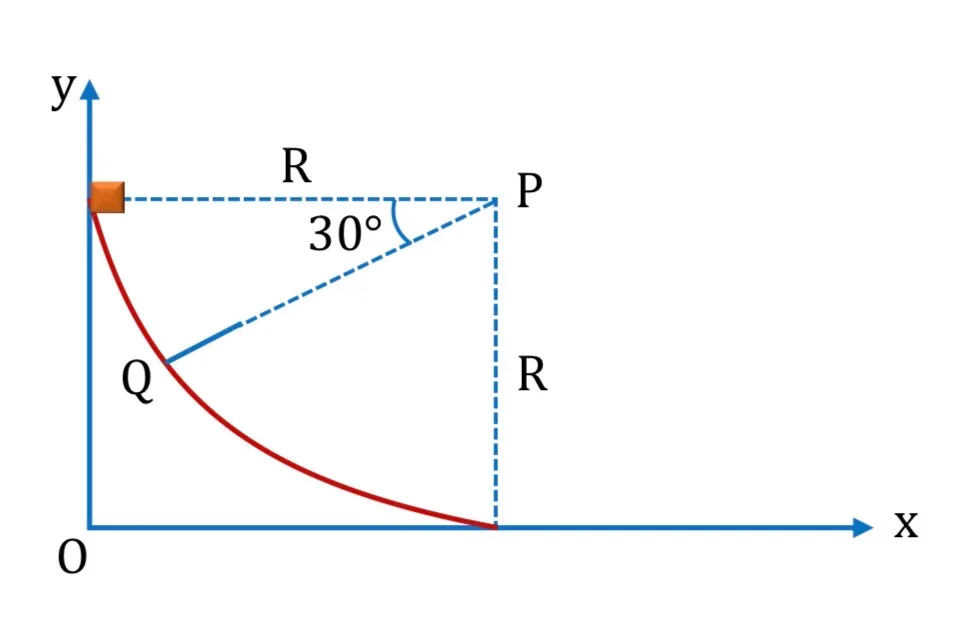
Sub-question 1
For the rough circular track described in the paragraph, the normal reaction at point Q is:
Options
Sub-question 2
For the same rough circular track, the speed of the block at point Q is:
Options
JEE Advanced 2013
Open question & full solution → - MCQmediumWave Optics
In YDSE with wavelength λ, what path difference corresponds to a point having half the peak intensity?
Options
JEE Advanced 2013
Open question & full solution →