Free question bank
Motion of Centre of Mass & Newton's Second Law questions with solutions
Practice Center of maas , Momentum and Collision questions for NEET and JEE Main. Attempt each question, then open the solution. Full revision programs are in the Physics courses.
Showing 1–10 of 28 questions
- NumericmediumCenter of maas , Momentum and CollisionOpen solution
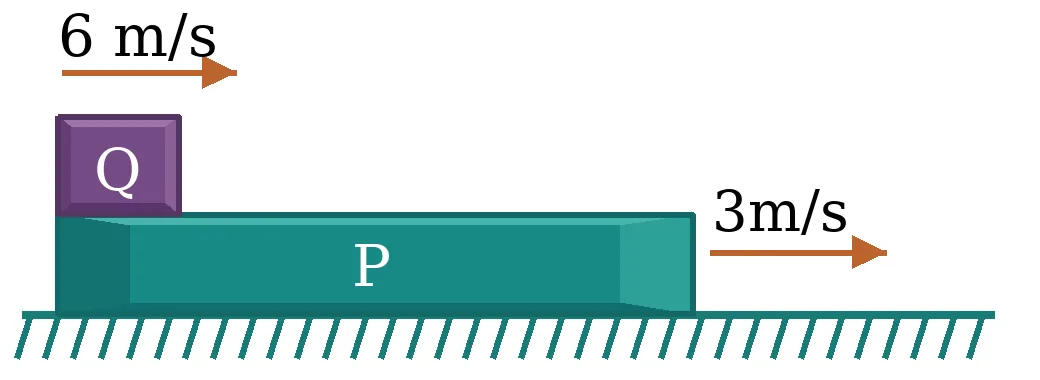
A plank P (mass twice the block Q) and a negligible-size block Q move on a smooth table with velocities 3 m s⁻¹ and 6 m s⁻¹ in the same direction. Plank length is 1 m. When Q reaches the far end it just stops slipping relative to P. Find coefficient of friction.
- MCQmediumCenter of maas , Momentum and CollisionOpen solution
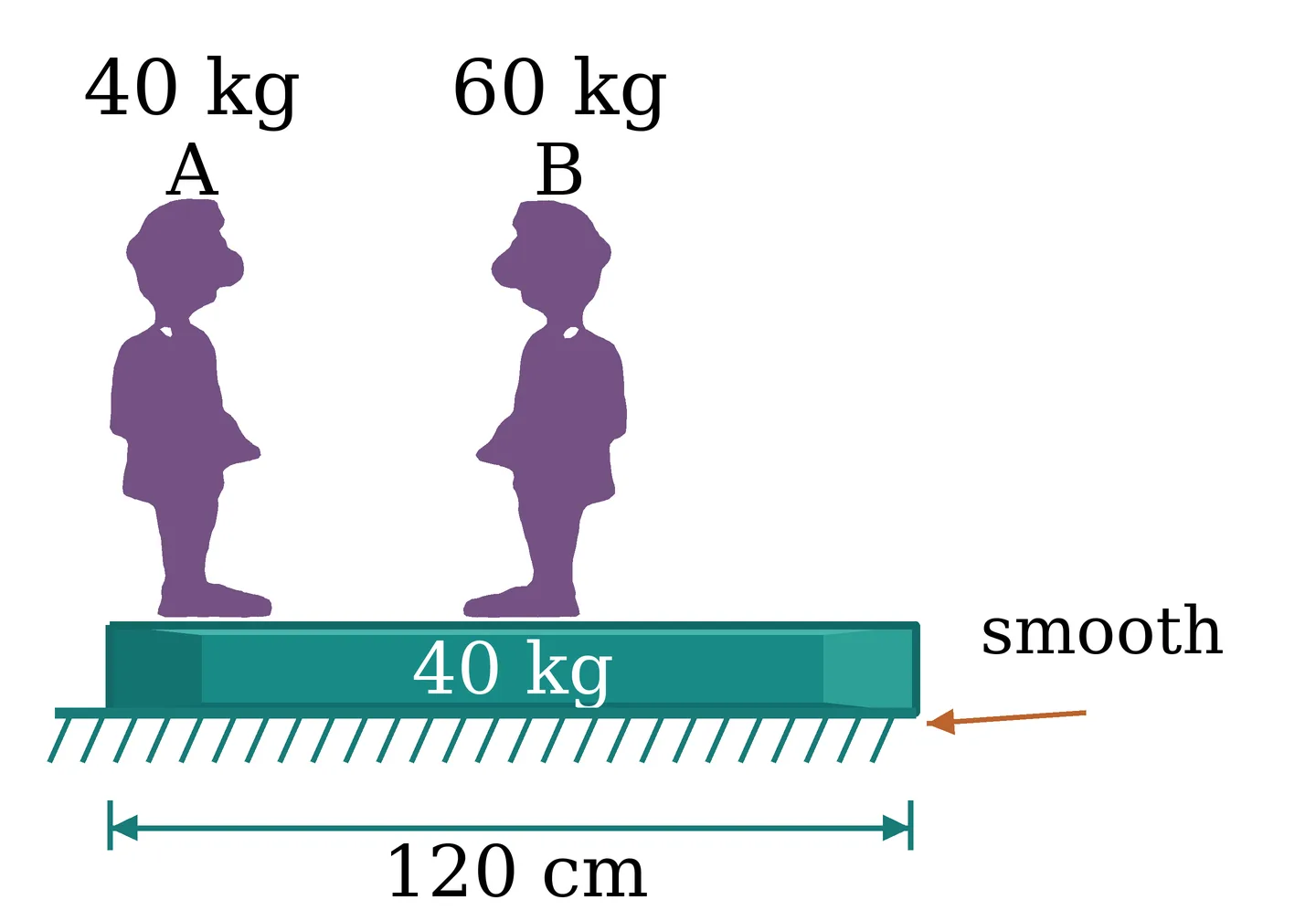
Two men A and B stand on a smooth plank; B is initially at the midpoint and A at the left end. They move so that B remains fixed with respect to ground until A meets B. Where do they meet?
Options
- MCQmediumCenter of maas , Momentum and Collision
Given below are two statements :
Statement I : For a mechanical system of many particles total kinetic energy is the sum of kinetic energies of all the particles.
Statement II : The total kinetic energy can be the sum of kinetic energy of the center of mass w.r.t. to the origin and the kinetic energy of all the particles w.r.t. the center of mass as the reference.
In the light of the above statements, choose the correct answer from the options given below :
Options
JEE Mains 202622 January Evening Shift
Open solution - NumericeasyCenter of maas , Momentum and CollisionOpen solution
Two particles of masses 2m and 3m move along the x-axis. At an instant their velocities are +10 m/s and -5 m/s respectively. If the velocity of the centre of mass is N m/s, find N.
- Multi-correctmediumCenter of maas , Momentum and CollisionOpen solution
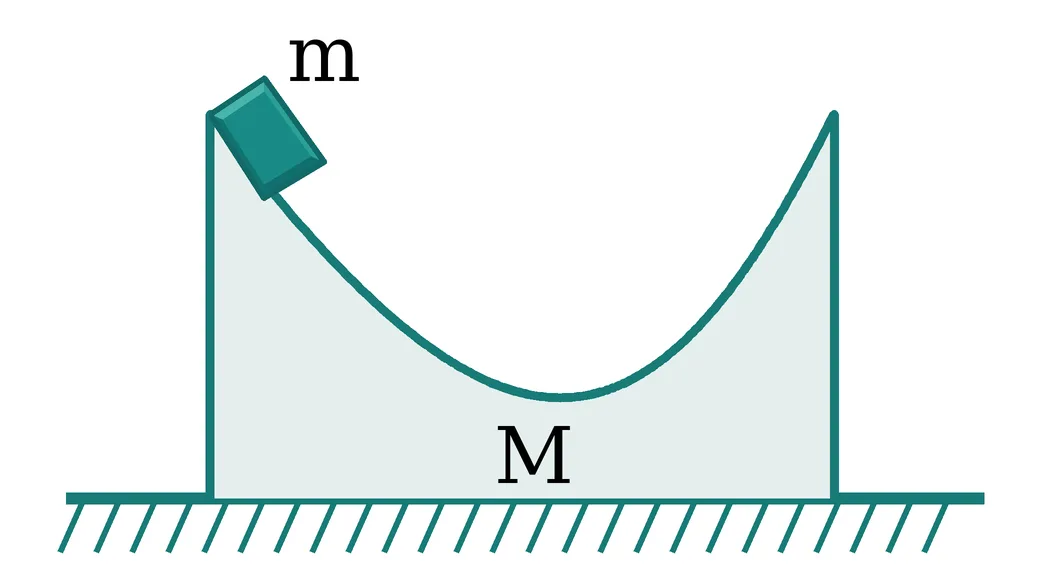
A small block is released from rest on a smooth wedge, all surfaces smooth. Considering wedge + block until the block attains maximum height on the wedge, which statements are correct?
Select all that apply
- MatchmediumCenter of maas , Momentum and CollisionOpen solution
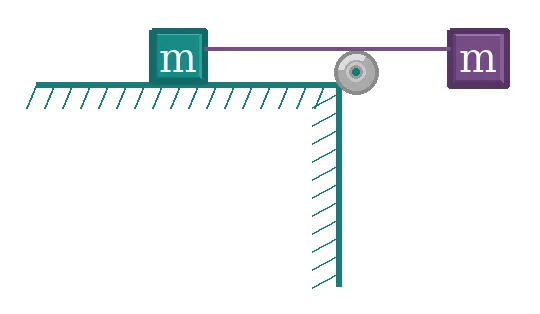
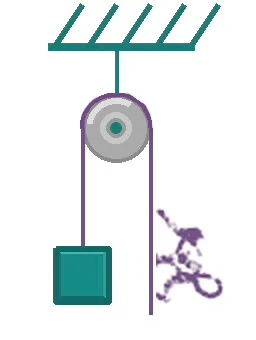
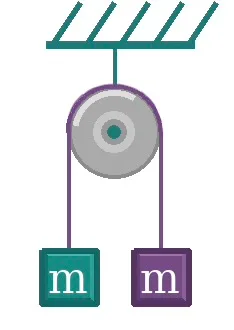
For each frictionless two-body system shown, consider motion from rest until any collision occurs. Match how the centre of mass shifts.
List 1
(A) Block slides on wedge on smooth floor
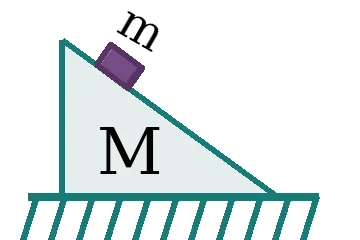
(B) Two blocks connected by horizontal string, one on smooth table
(C) Monkey and block of equal mass connected by rope; monkey climbs
(D) Two hanging equal blocks, left block initially given downward velocity u
List 2
(P) Shifts towards right
(Q) Shifts downwards
(R) Shifts upwards
(S) Does not shift
Options
- Multi-correctmediumCenter of maas , Momentum and CollisionOpen solution
Two charges move under only their mutual attraction, initially far apart. Which statements are correct?
Select all that apply
- Multi-correctmediumCenter of maas , Momentum and CollisionOpen solution
For a system of particles of constant total mass M, which statements are correct?
Select all that apply
- MCQmediumCenter of maas , Momentum and CollisionOpen solution
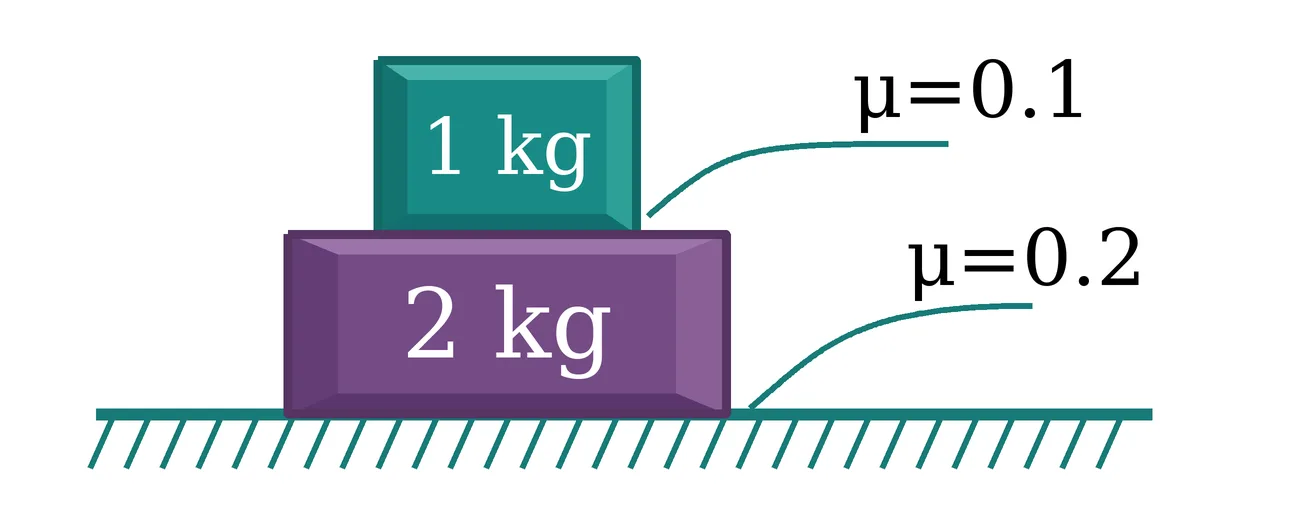
Two stacked blocks are given a common horizontal velocity to the right. The coefficient between them is 0.1 and between lower block and ground is 0.2, masses as shown. Subsequent acceleration of centre of mass is:
Options
- MCQeasyCenter of maas , Momentum and Collision
Two identical bodies A and B have equal masses. Their initial velocities are = 4î m·s⁻¹ and = 4ĵ m·s⁻¹, respectively. Body A has constant acceleration = 6î + 6ĵ m·s⁻², while body B has zero acceleration. What is the path followed by the centre of mass of the two-body system?
Options
JEE Mains 2026 6 April Evening Shift
Open solution