Free question bank
Electrostatic Self-Energy & Equipotential Surfaces questions with solutions
Practice Electrostatic questions for NEET and JEE Main. Attempt each question, then open the solution. Full revision programs are in the Physics courses.
Showing 1–10 of 21 questions
- MCQmediumElectrostaticOpen solution
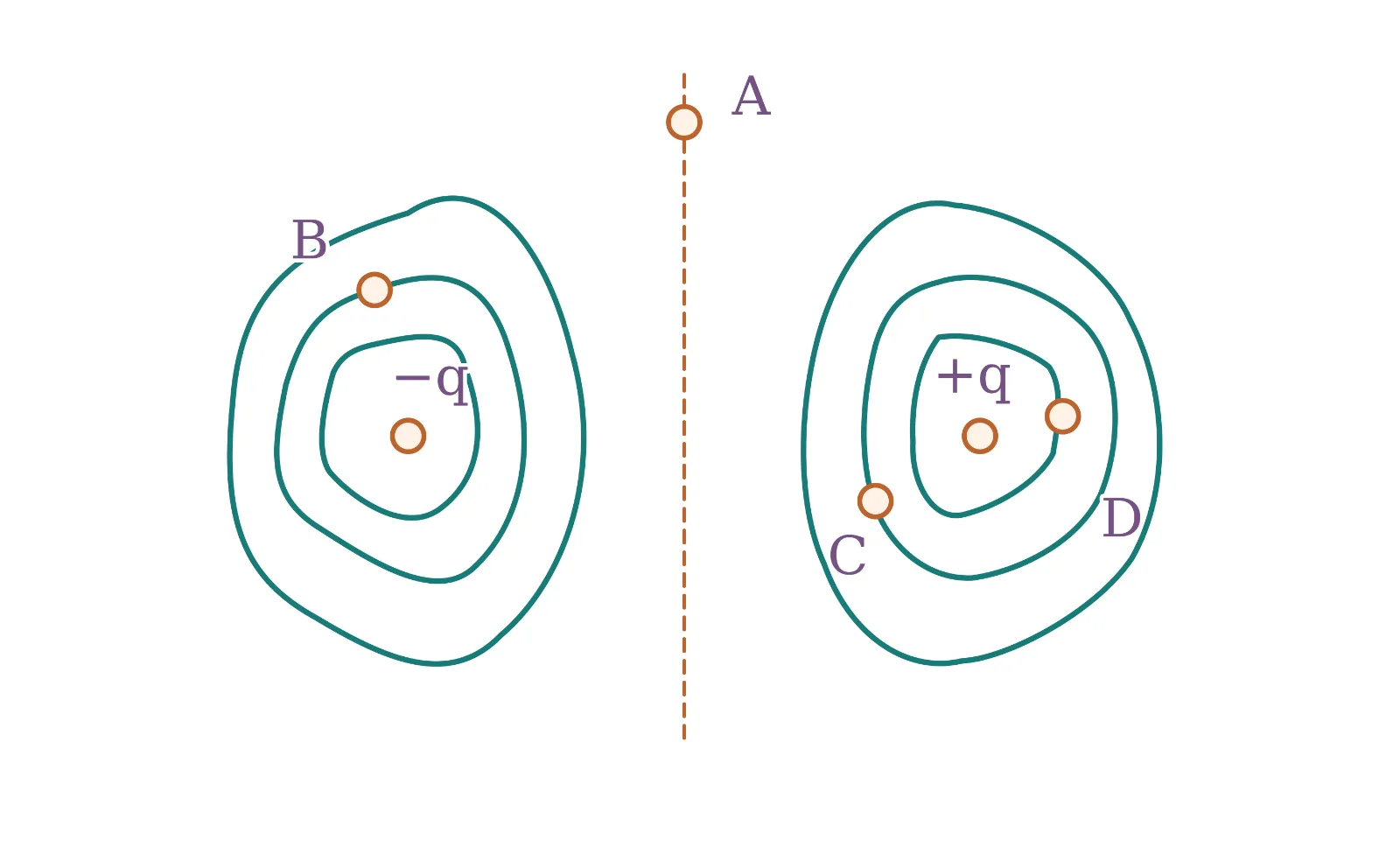
Figure shows equi-potential surfaces for a two charges system. At which of the labeled points point will an electron have the highest potential energy?
Options
- MCQeasyElectrostaticOpen solution
The angle between the electric lines of force and the equipotential surface is:
Options
- MCQmediumElectrostaticOpen solution
In a thin spherical shell charged by some source, the potential difference between two points C and P (where r is as shown in figure) is: [Diagram: Image]
Options
- MCQmediumElectrostaticOpen solution
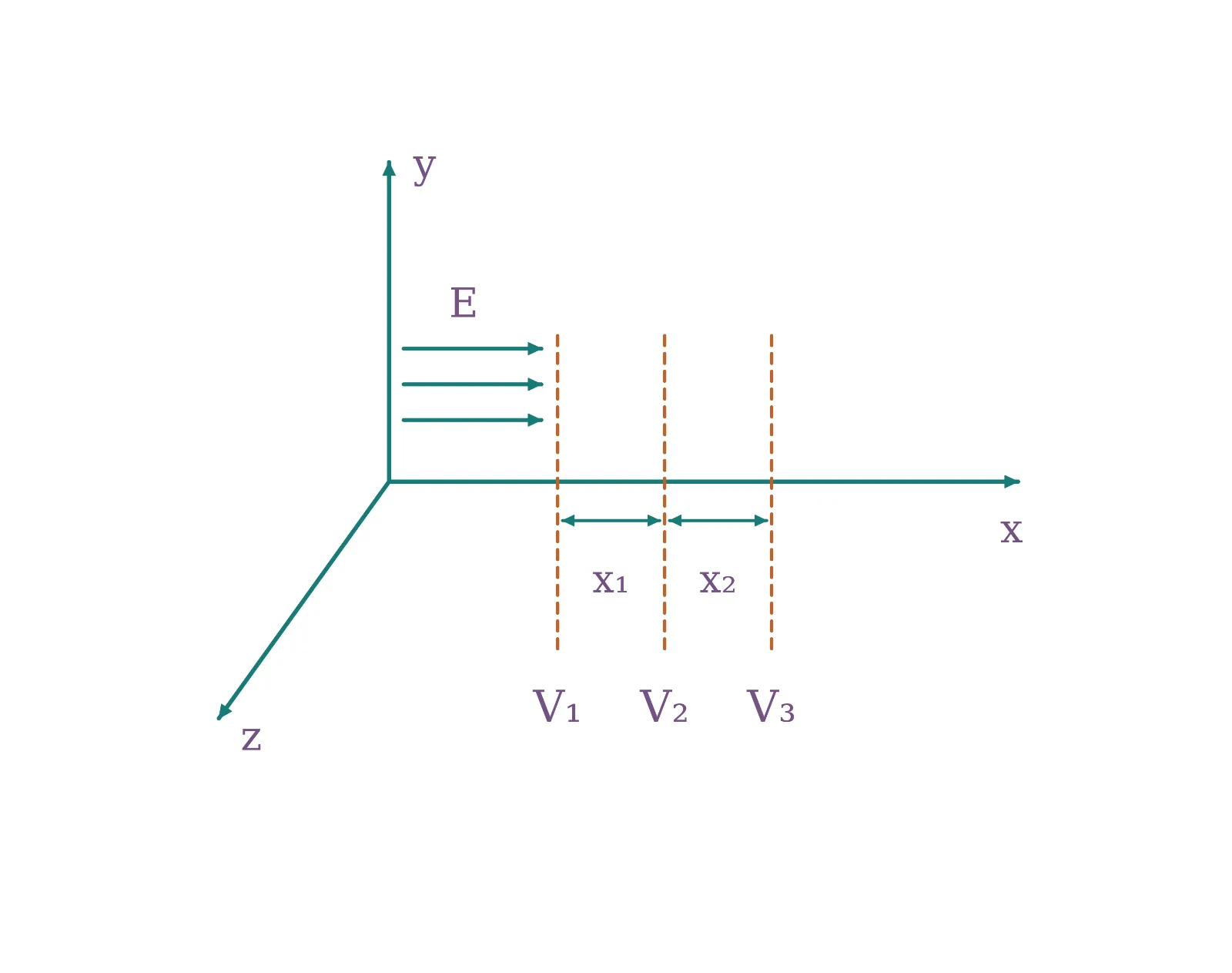
In the electric field shown, three equipotential surfaces have potentials V₁, V₂ and V₃. The field magnitude depends on x as E = 2x² V m⁻¹, and V₁ - V₂ = V₂ - V₃. If the separations are x₁ and x₂ as shown, then:
Options
- MCQeasyElectrostaticOpen solution
Two hollow conducting spheres of radii R₁ and R₂ (R₁ ≫ R₂) have equal charges. The potential would be:
Options
- MCQeasyElectrostaticOpen solution
Two metal spheres of radii R and 2R have same uniform surface charge density σ. They are brought in contact and separated. The new charge densities on them will be:
Options
- A/ReasyElectrostatic
Given below are two statements : one is labelled a Assertion (A) and the other is labelled as Reason(R) In the light of the above statements, choose the most appropriate answer from the options given below :
Assertion
Assertion (A) : Work done by electric field on moving a positive charge on an equipotential surface is always zero.
Reason
Reason (R) : Electric lines of forces are always perpendicular to equipotential surfaces.
Options
JEE Mains 2024 27 Jan Evening Shift
Open solution - MCQmediumElectrostaticOpen solution
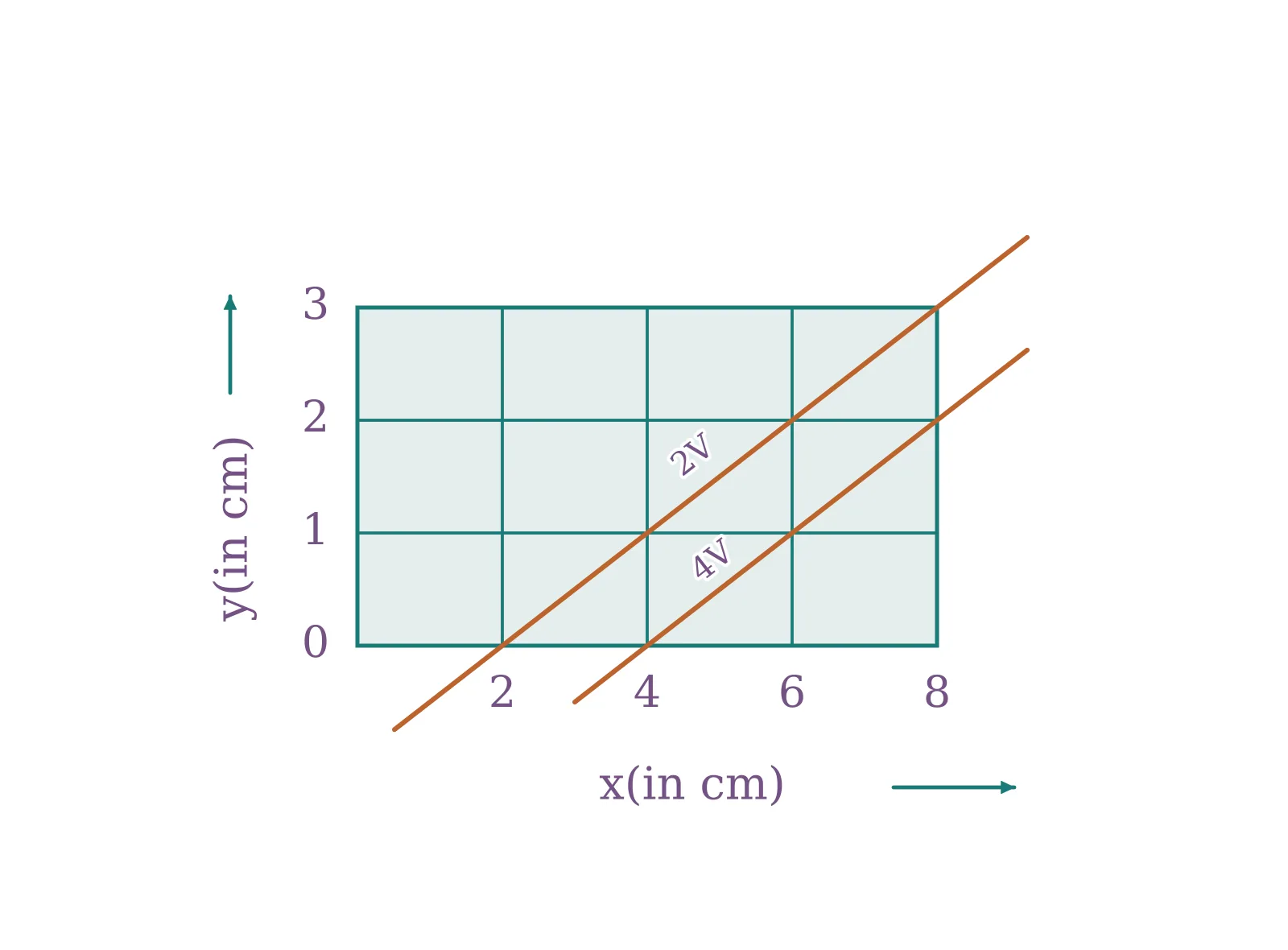
The figure shows two equipotential lines in the xy-plane. The x-component Eₓ and y-component Eᵧ of the electric field in the region between these equipotential lines are, respectively:
Options
- MCQeasyElectrostaticOpen solution
Some charge is being given to a conductor. Then, its potential:
Options
- MCQmediumElectrostaticOpen solution
The diagrams show four regions of equipotentials. The maximum work required to move charge in which case is: [Diagram: Image]
Options