Free question bank
Dispersion, Dispersive Power & Prism Combinations questions with solutions
Practice Geometrical optics questions for NEET and JEE Main. Attempt each question, then open the solution. Full revision programs are in the Physics courses.
Showing 1–10 of 21 questions
- MCQmediumGeometrical opticsOpen solution
An achromatic convergent doublet of two lenses in contact has a power of + 2D. The convex lens has a power + 5D. What is the ratio of the dispersive powers of the convergent and divergent lenses
Options
- MCQdifficultGeometrical opticsOpen solution
A flint glass convex lens of focal length 16 cm is placed in contact with crown glass lens. The refractive indices of crown glass for violet and red colour are μv = 1.525, μr = 1.515 and for flint glass μv' = 1.655 and μr' = 1.645. (a) Find the nature and focal length of the crown glass lens which will form an achromatic combination with the flint glass lens. (b) What is the focal length of the combination?
Options
- MCQmediumGeometrical opticsOpen solution
The dispersive powers of the materials of the two lenses are in the ratio 4 : 3. If the achromatic combination of these two lenses in contact is a convex lens of focal length 60 cm then the focal lengths of the component lenses are
Options
- MCQmediumGeometrical opticsOpen solution
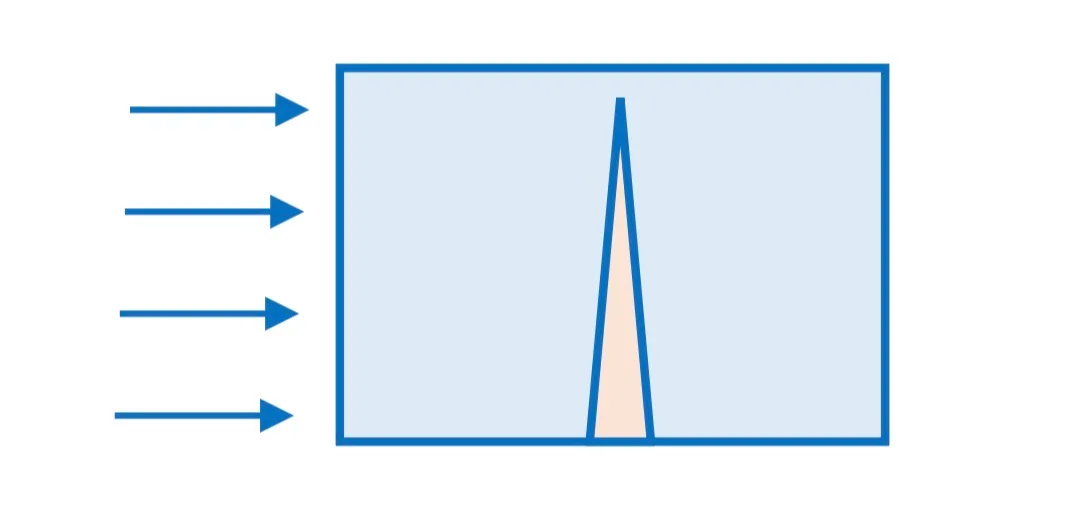
A thin isosceles prism with angle 4° and refractive index 5/4 is placed inside a transparent tube with liquid (refractive index = 1.5) as shown. The deviation of light due to prism will be :-
Options
- MCQmediumGeometrical optics
Two thin prisms of re indices 1.54 and 1.72 are arranged so that their deviations cancel. If the first prism angle is 4°, find the second prism angle.
Options
JEE Mains 2025 28 Jan Morning Shift
Open solution - MCQmediumGeometrical opticsOpen solution
A thin prism P₁ with angle 4° and made from a glass of refractive index 1.54 is combined with another thin prism P₂ made from glass of refractive index 1.72 to produce dispersion without deviation. The angle (in degree) of the prism P₂ is :-
Options
- MCQmediumGeometrical opticsOpen solution
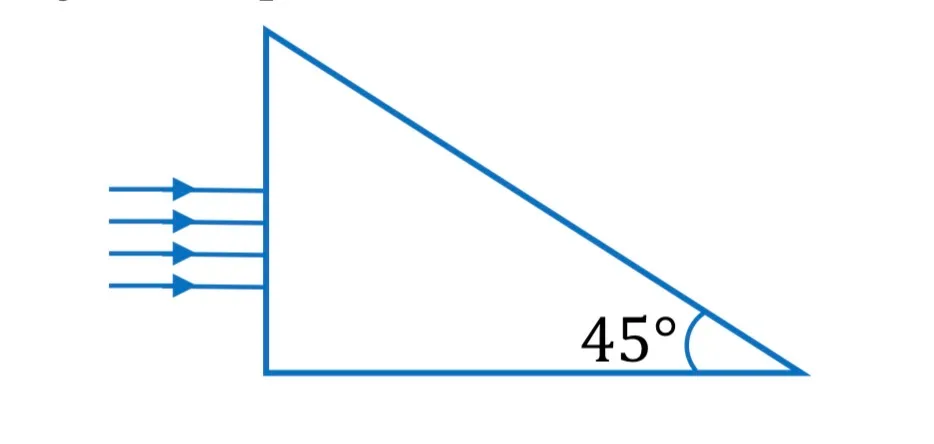
A beam of light consisting of red, green and blue and is incident on a right-angle prism. The refractive index of the material of the prism for the above red, green and blue wavelengths are 1.39, 1.44 and 1.47 respectively. The prism will
Options
- MCQmediumGeometrical opticsOpen solution
Two thin prisms of flint glass, with refracting angles of 6° and 8° respectively, possess dispersive powers in the ratio :
Options
- MCQmediumGeometrical opticsOpen solution
When white light passes through a glass prism, one gets spectrum on the other side of the prism. In the emergent beam, the ray which is deviating least is or deviation by a prism is lowest for
Options
- MCQeasyGeometrical optics
A thin prism with angle 5° of refractive index 1.72 is combined with another prism of refractive index 1.9 to produce dispersion without deviation. The angle of second prism is ______.
Options
JEE Mains 202623 January Morning Shift
Open solution