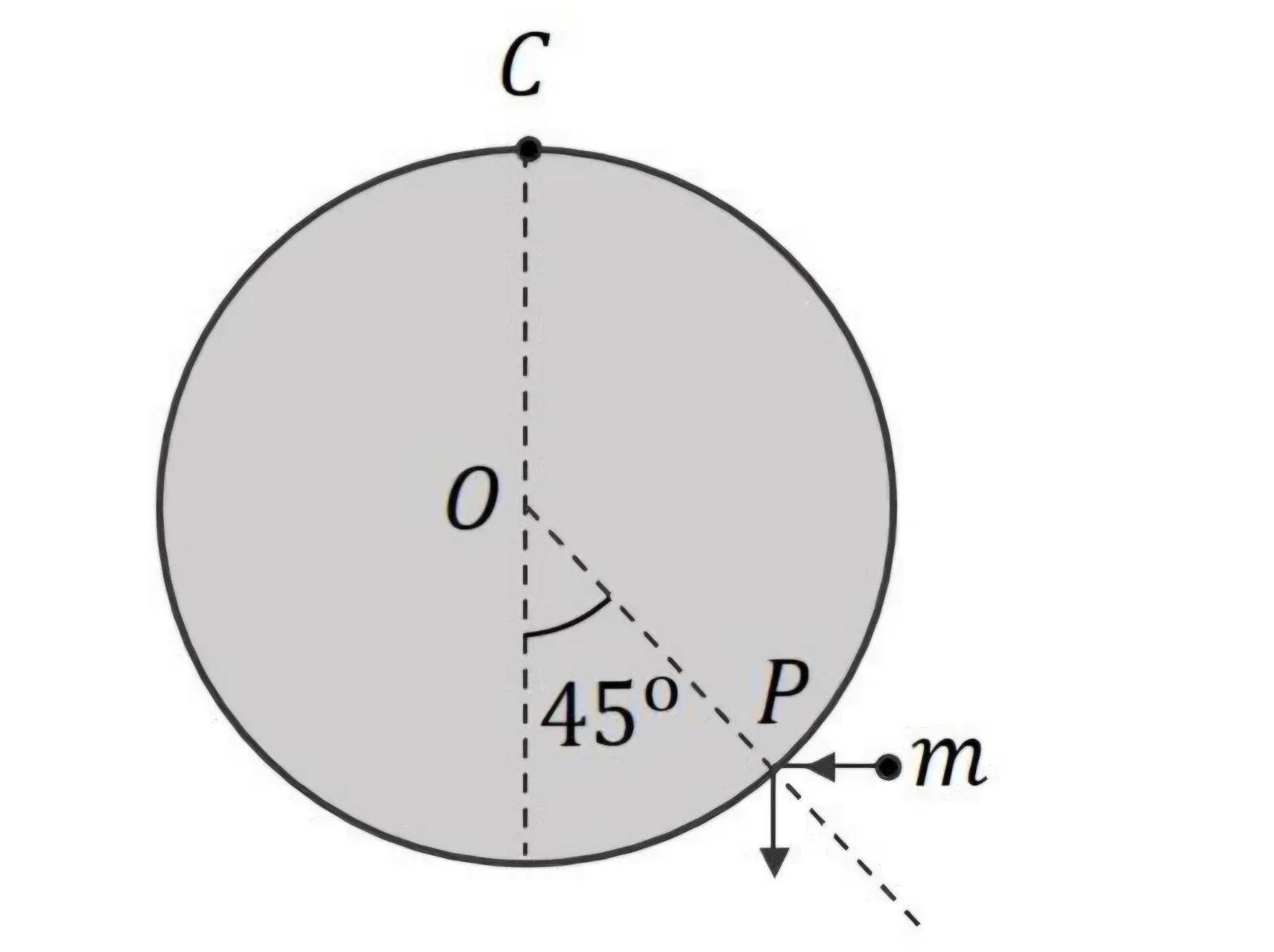
A uniform circular disk of radius 0.2 m and mass 1 kg is pivoted at its top point C such that it can rotate freely around C in the XY plane, as shown in the figure. Initially, when the disk is at rest, a particle of mass 20 g, travelling along negative x direction in the XY plane with speed 100 m s⁻¹, hits the circumference of the disk at a point P. After collision the particle moves along negative y direction at a speed of 90 m s⁻¹. [Given: acceleration due to gravity g = -10ĵ m s⁻².]
Physics · Rotational Motion · angular impulse in pure rotation and rotational collision
A uniform circular disk of radius 0.2 m and mass 1 kg is pivoted at its top point C such that it can rotate freely around C in the XY plane, as shown in the figure. Initially, when the disk is at rest, a particle of mass 20 g, travelling along negative x direction in the XY plane with speed 100 m s⁻¹, hits the circumference of the disk at a point P. After collision the particle moves along negative y direction at a speed of 90 m s⁻¹. [Given: acceleration due to gravity g = -10ĵ m s⁻².]
Sub-question 1
After the collision the disk starts to rotate around point C in the XY plane. The maximum change in the height (in m) of its center O is:
Sub-question 2
Amount of energy loss (in J) in the collision is: