Free question bank
Reaction Intermediates: Carbocations, carbanions, free radicals, electrophiles, and nucleophiles. questions with solutions
Practice Organic Chemistry - Some Basic Principles and Teachniques questions for NEET and JEE Main. Attempt each question, then open the solution. Full revision programs are in the Physics courses.
Showing 1–10 of 145 questions
- MCQmediumOrganic Chemistry - Some Basic Principles and TeachniquesOpen solution
Which behaves both as a nucleophile as well as an electrophile?
Options
- MCQmediumOrganic Chemistry - Some Basic Principles and TeachniquesOpen solution
Dehydrohalogenation of an alkyl halide is a/an
Options
- MCQmediumOrganic Chemistry - Some Basic Principles and TeachniquesOpen solution
Which of the following is not a nucleophile?
Options
- MCQeasyOrganic Chemistry - Some Basic Principles and TeachniquesOpen solution
Which of the following compounds is resistant to nucleophilic attack by hydroxy ion?
Options
- MCQeasyOrganic Chemistry - Some Basic Principles and TeachniquesOpen solution
The most stable carbocation is :
Options
- MCQeasyOrganic Chemistry - Some Basic Principles and TeachniquesOpen solution
Due to presence of an unpaired electron, free radicals are
Options
- MCQeasyOrganic Chemistry - Some Basic Principles and TeachniquesOpen solution
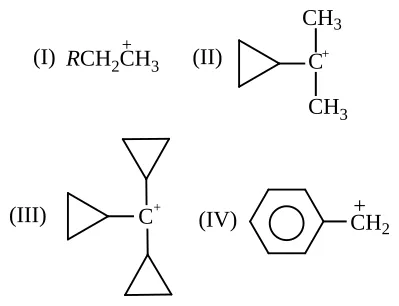
In the following carbocations, the stability order is : | |
GOC_1_0010_Q.png
Options
- MCQmediumOrganic Chemistry - Some Basic Principles and TeachniquesOpen solution
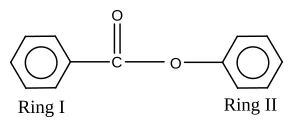
In the compound electrophilic substitution occurs at
GOC_1_1022_Q.png
Options
- MCQmediumOrganic Chemistry - Some Basic Principles and TeachniquesOpen solution
An electrophilic reagent must have
Options
- MCQeasyOrganic Chemistry - Some Basic Principles and TeachniquesOpen solution
Bromination of alkanes involves
Options