Free question bank
Angular Impulse & Rotational Collisions questions with solutions
Practice Rotational Motion questions for NEET and JEE Main. Attempt each question, then open the solution. Full revision programs are in the Physics courses.
Showing 1–10 of 20 questions
- MCQeasyRotational MotionOpen solution
Disc I₁ rotates at angular speed ω. A second disc I₂ is laid coaxially on it at rest; they eventually rotate together. Find the combined angular speed.
Options
- MCQmediumRotational MotionOpen solution
A uniform rod of length l and mass M rotating about a fixed vertical axis on a smooth horizontal table. It elastically strikes a particle placed at a distance l/3 from its axis and stops. Mass of the particle is
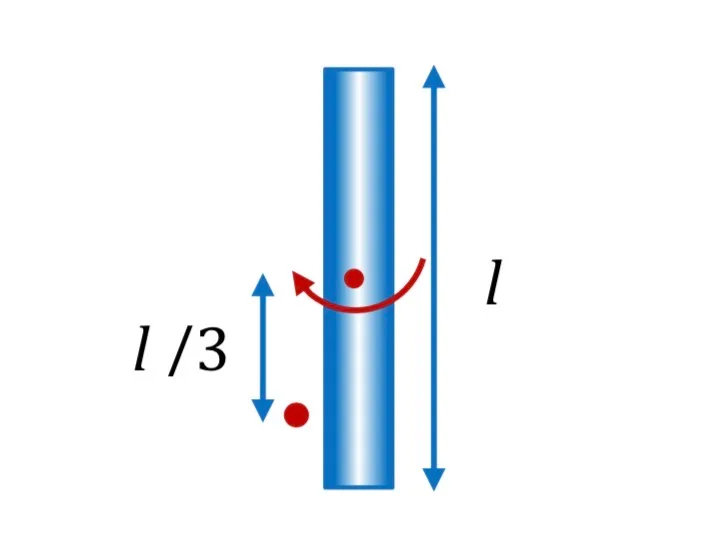
Options
- ParagraphdifficultRotational MotionOpen solution
A uniform circular disk of radius 0.2 m and mass 1 kg is pivoted at its top point C such that it can rotate freely around C in the XY plane, as shown in the figure. Initially, when the disk is at rest, a particle of mass 20 g, travelling along negative x direction in the XY plane with speed 100 m s⁻¹, hits the circumference of the disk at a point P. After collision the particle moves along negative y direction at a speed of 90 m s⁻¹. [Given: acceleration due to gravity g = -10ĵ m s⁻².]
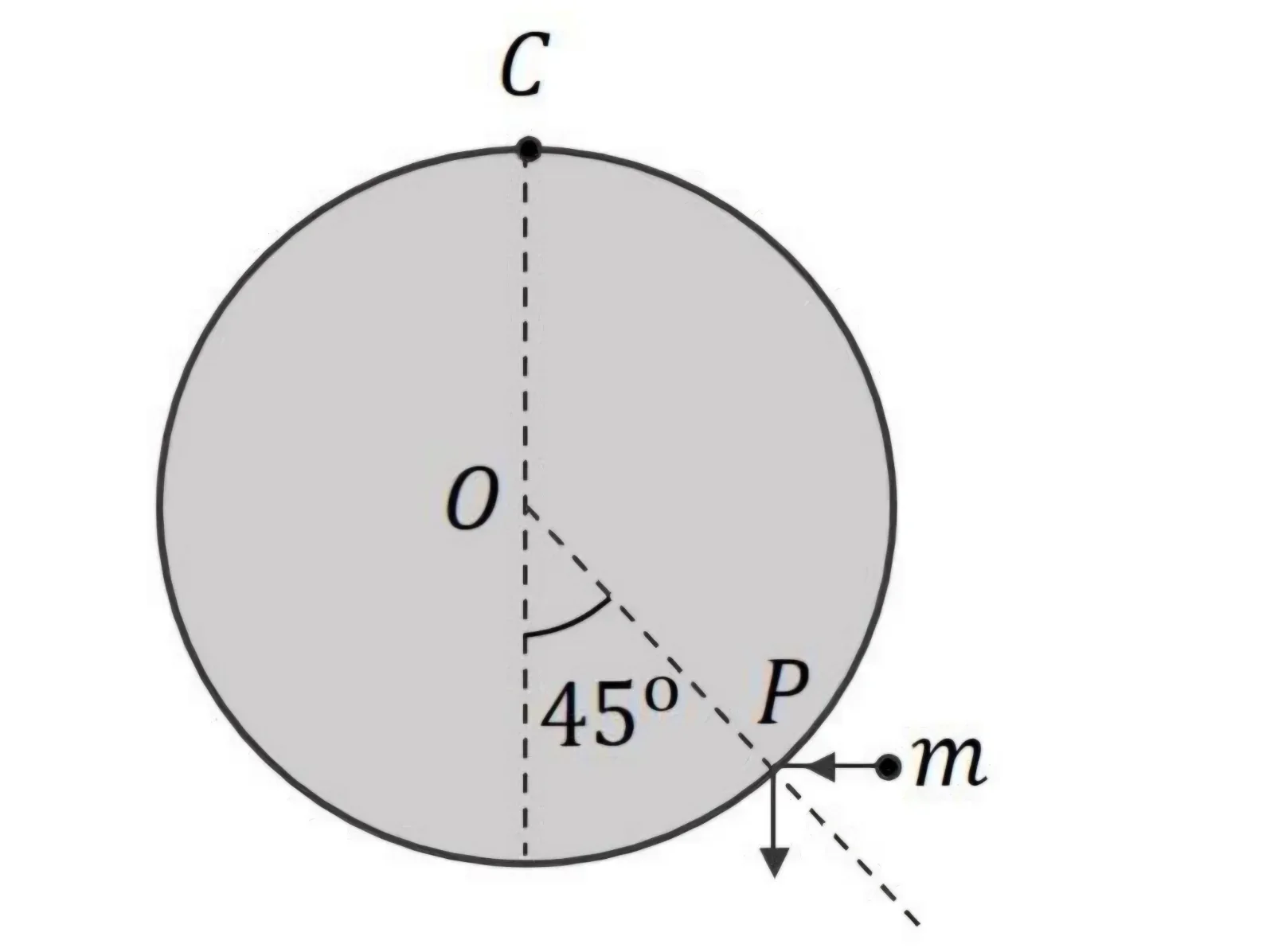
Sub-question 1
After the collision the disk starts to rotate around point C in the XY plane. The maximum change in the height (in m) of its center O is:
Sub-question 2
Amount of energy loss (in J) in the collision is:
- NumericmediumRotational MotionOpen solution
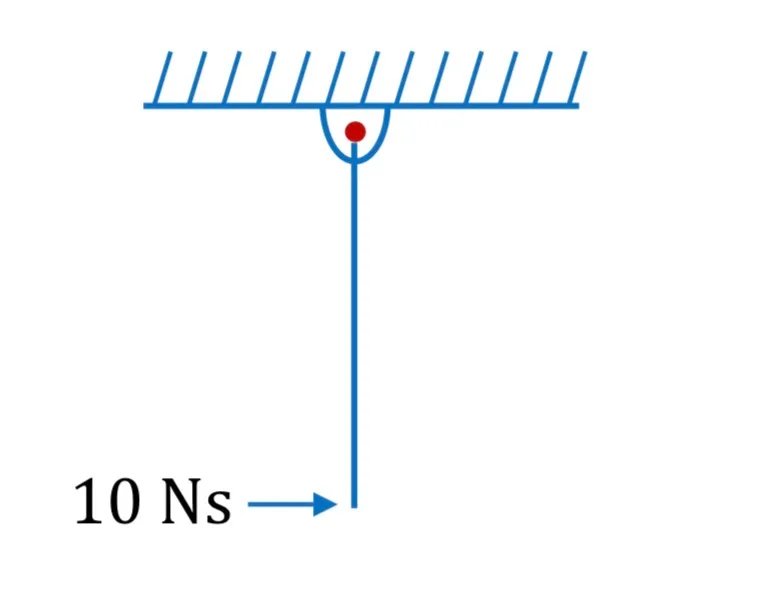
A thin uniform straight rod of mass 2 kg and length 1 m is free to rotate about its upper end when at rest. It receives an impulsive blow of 10 Ns at its lowest point, normal to its length as shown in figure. Find the kinetic energy of rod just after impact.
- NumericmediumRotational MotionOpen solution
A rod of mass M and length L lies on a horizontal frictionless surface. A particle of mass m moving perpendicular to the rod with speed u strikes one end elastically and comes to rest. If m/M = 1/x, find x.
- MCQmediumRotational MotionOpen solution
Disc 1 has mass 2 kg, radius 0.2 m and angular speed 50 rad/s. Disc 2 has mass 4 kg, radius 0.1 m and angular speed 200 rad/s in the same sense. They touch coaxially and eventually co-rotate. Find final angular speed.
Options
- MCQmediumRotational MotionOpen solution
A mass m is moving at speed v perpendicular to a rod of length d and mass M = 6m which pivots around a frictionless axle running through its centre. It strikes and sticks to the end of the rod. The moment of inertia of the rod about its centre is Md²/12. Then the angular speed of the system right after the collision is
Options
- MCQmediumRotational MotionOpen solution
Two discs with the same moment of inertia I initially rotate at angular speeds ω₁ and ω₂ about their common axes. They are brought face-to-face and acquire the same final angular speed. Find rotational energy lost.
Options
- MCQmediumRotational MotionOpen solution
A bar of mass M = 1.00 kg and length L = 0.20 m is lying on a horizontal frictionless surface. One end of the bar is pivoted at a point about which it is free to rotate. A small mass m = 0.10 kg is moving on the same horizontal surface with 5.00 m·s⁻¹ speed on a path perpendicular to the bar. It hits the bar at a distance L/2 from the pivoted end and returns back on the same path with speed v. After this elastic collision, the bar rotates with an angular velocity ω. Which of the following statement is correct?
Options
- MCQmediumRotational MotionOpen solution
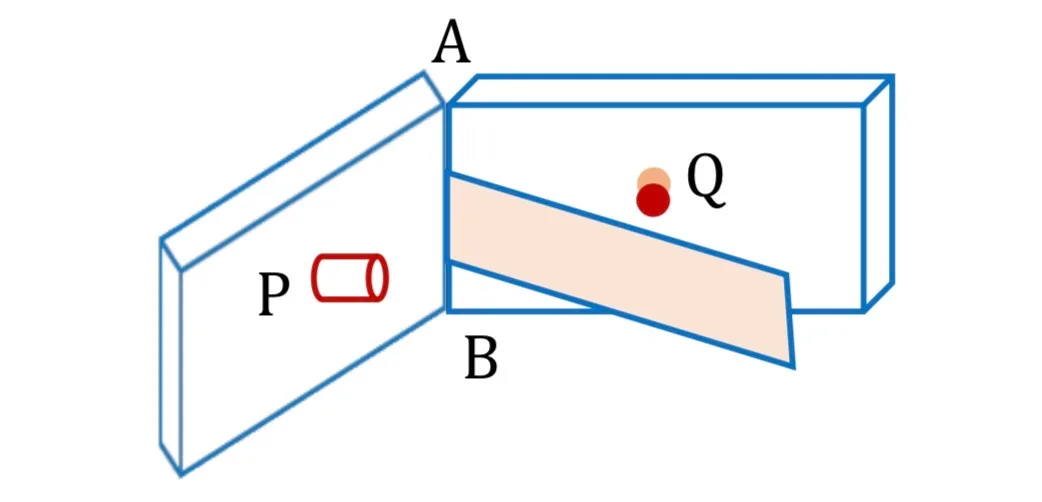
A laminar sheet of mass 30 kg is hinged along AB between two perpendicular heavy plates. Its moment of inertia about an axis through its centre of mass parallel to AB is 1.2 kg·m². Obstacles P and Q are each 0.5 m from AB. The sheet hits an obstacle with angular speed 1 rad/s, reverses, and receives impulse 6 N·s at each impact. Which option correctly gives (i) CM distance from AB, (ii) angular speed after the first impact, and (iii) whether it ever comes to rest?
Options